Transit is the Answer to climate change
December 15, 2022
December 15, 2022

After more than a year of engagement, the RTA has released a draft regional transit strategic plan, Transit is the Answer, which the RTA Board of Directors will consider for adoption during their February 16 meeting. The natural follow-up question is: Transit is the answer to what?
The RTA has published a series of blogs that dive into the idea that transit is the answer to some of the most urgent challenges facing our region. Chicagoland’s public transit system contributes to our region’s economic, social, and environmental health in ways and at a scale nothing else can. Unless otherwise cited, the following data points come from Transit is the Answer.
In our region, transportation overall accounts for 32 percent of our total emissions, making it one of the biggest sources of carbon dioxide emissions—the largest contributing factor to climate change. A strong public transportation system offers our region the greatest opportunity to reduce carbon emissions. In 2018, the regional transit system saved an estimated 3.7 million metric tons of greenhouse gas emissions, the equivalent of taking one of Illinois’ remaining coal-fired power plants offline.
Unfortunately, our region is not moving in the right direction, and transit is the answer to get us back on track. An October greenhouse gas report from the Chicago Metropolitan Agency for Planning (CMAP) found that, from 2010 to 2019, transportation emissions in our region increased while emissions from all other sectors decreased. During this period, fuel efficiency improved, but transportation emissions still went up because there was more driving. Across the RTA region, public transportation accounted for less than 2 percent of all greenhouse gas emissions from transportation in 2019, while passenger vehicles were responsible for 59 percent. Transit produces less than half the greenhouse gas emissions that driving does per passenger mile. This data shows to reduce transportation emissions over the next 10 years, the region will need to reduce driving. Making it easier for people to drive less and choose transit, walking, and biking more often will be key to making progress on regional climate goals.
If our transit system were shut down tomorrow, people would drive an estimated 1.7 billion additional miles over the course of a year, leading to 375,000 metric tons of additional greenhouse gas emissions—nearly double the impact of losing all the forest preserves across Cook, DuPage, Lake, Kane, McHenry, and Will Counties.
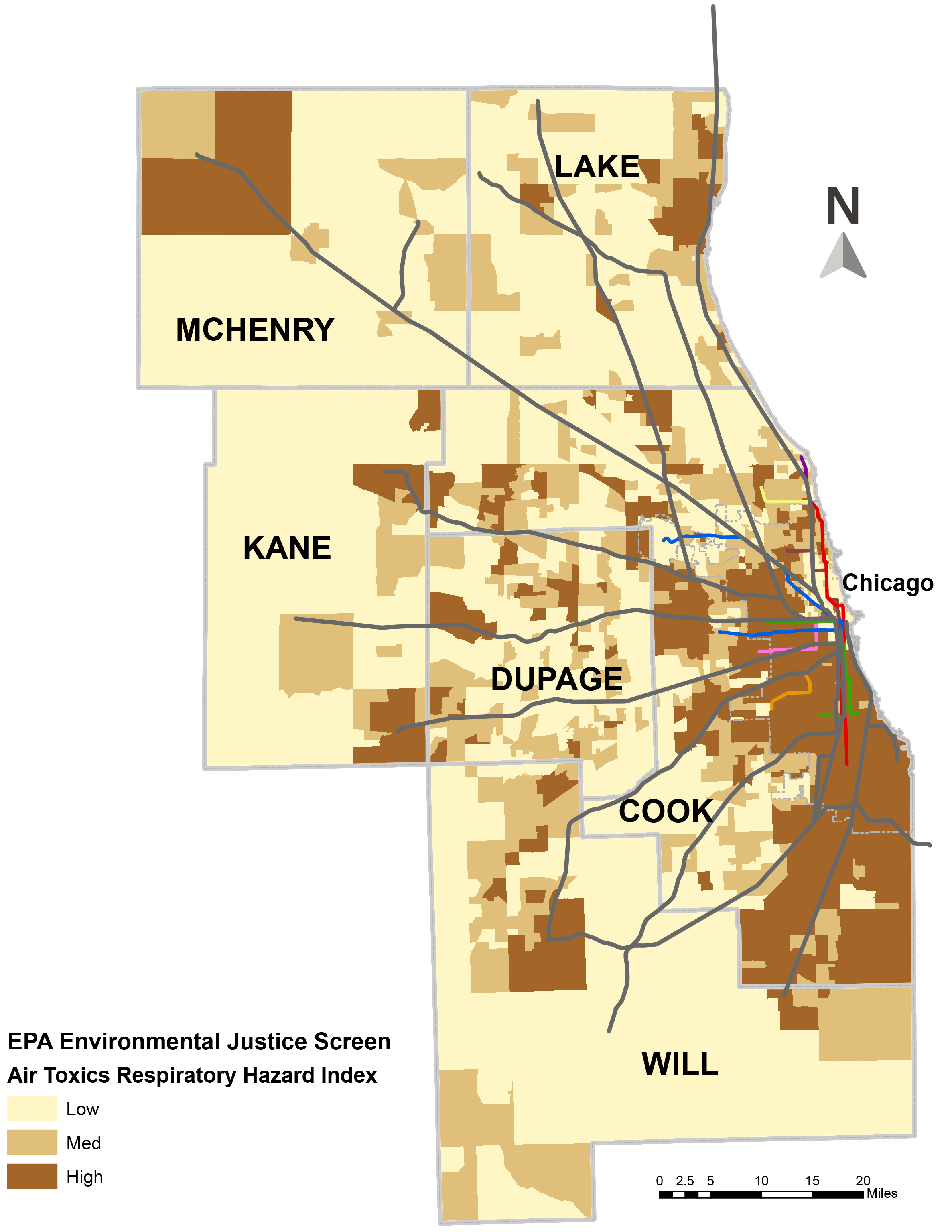
Transit is the Answer looks at the importance of transit in reducing emissions from an equity perspective. As explained in the plan, the impacts of air pollution from cars, trucks, and other sources are not distributed evenly across our region. People of color and low-income populations are disproportionately exposed to higher levels of dangerous air pollution and suffer negative health outcomes as a result.
The CTA and Pace have acknowledged this reality, and their electric bus rollout centers equity by placing the electric buses and electric bus garages in areas with low air quality first. The RTA will continue to grapple with the inequitable impact of air pollution in future development of a regional climate action plan, as called for in Transit is the Answer. The agency will also explore new ways to measure the impacts transit improvements have on air quality and whether those impacts are equitable.
Intersection of Poor Air Quality and Concentrations of Low-Income Populations and People of Color as Defined by the U.S. Environmental Protection Agency (EPA)
No other mode can move people as quickly, efficiently, and cleanly as transit does. According to the U.S. Department of Transportation Federal Highway Administration, each car in the U.S. carries an average of 1.67 passengers, so a standard bus can remove 31 cars from the road, one CTA railcar can remove 36 cars, and one Metra railcar can remove 83 cars.
According to the American Public Transportation Association (APTA), public transportation’s overall effects save the U.S. 6 billion gallons of gasoline a year. In our region, the transit system will continue having an even larger impact on fossil fuel consumption as the CTA, Metra, and Pace carry out their plans to electrify.
The CTA has committed to an all-electric bus fleet by 2040 under a Chicago City Council resolution passed in 2019. Purchasing new all-electric buses is only one part of the equation. To operate and support a fleet of eBuses also requires extensive charging infrastructure and significant electrical power upgrades across the service area. To help guide its conversion efforts, in February 2022 the agency released Charging Forward, a comprehensive strategic planning study that lays out exactly how the CTA will meet this goal. The CTA has been at the forefront of the shift to electric bus technology since their first two electric buses entered service in 2014, making them one of the first transit agencies in the country to run electric buses in revenue service.
Metra is working to convert three older diesel locomotives to zero-emission battery power, making them one of the first in the industry to explore this new technology. This move will reduce nitrogen oxide emissions by more than 100 tons per year and particulate matter emission by more than 2 tons per year. Metra is also seeking to buy low-emission and zero-emission switch engines.
Pace has been a nationwide leader in exploring alternative fuels and reducing emissions. The agency has committed to being zero emission by 2040 as part of its new strategic plan, Driving Innovation, adopted in September 2021. In fact, zero emission fleet transition is listed as the agency’s top goal in the plan. As part of the plan, Pace has committed to buying no diesel buses in its 5-Year Capital Plan with $50 million programmed for electric bus purchases.
Transit is the Answer calls on the RTA to lead the creation of a regional transit climate action plan that builds on the existing plans from the CTA, Metra, and Pace. The plan will identify how transit can support the region’s climate action goals, outline regional strategies that will encourage more people to ride transit, and chart a course to reduce the footprint of the transit system and move toward zero-emissions for transit operations. Transit is the Answer also includes new performance measures related to the region winning the fight against climate change, including measuring how many tons of carbon dioxide are offset by using transit versus driving, overall regional transit system emissions, and more.
Transit is the answer to many of the most urgent challenges facing us today, and investing in transit is key to advancing equity, growing our economy, and combating climate change. We anticipate federal COVID-19 relief funding to last through 2025. After that, our transit system faces a $730 million annual budget gap that cannot be closed by raising fares or cutting service—increased public funding is essential.
Transit is the Answer identifies potential funding solutions and lays out an agenda for advocacy and action that addresses safety, reliability, speed, and other improvements to the system. It is our shared responsibility to build a sustainable model of investment in the operations, upkeep, and modernization of our regional public transportation assets. Join our coalition to take future action and advocate with us for these solutions.
Subscribe to our Newsletter
Related Articles
 Transit station activation in Uptown brings positive presence to Broadway bus route with weekly outdoor yoga class
On Friday mornings now through the end of the year, CTA #36 and #81 bus riders and Red Line passengers through the Uptown neighborhood of Chicago may catch a...
July 25, 2024 Join the RTA Transit is the Answer Coalition to discuss possible reforms to improve service and accountability for riders
Following the introduction of legislation that proposes changes to how the Chicago region’s transit agencies are organized, the RTA continues to lead convers...
July 15, 2024 RTA releases new fare equity report, recommending fully funding and expanding reduced fare programs
A new report released by the RTA in July, Building a More Equitable Fare Structure for Public Transit in the Chicago Region, recommends that the state legisl...
July 11, 2024 Homewood, Richton Park adopt transit-oriented development plans funded through RTA Community Planning program
This spring, transit-oriented development (TOD) plans were adopted by the villages of Homewood and Richton Park that will make these communities more transit...
July 11, 2024 Good news: Regional transit ridership reaches new high as CTA, Metra, and Pace increase service, offer new fare products
Ridership across Chicago’s transit system has continued to increase, with May 2024 seeing the highest ridership levels since 2019 for CTA, Metra, and Pace. T...
June 28, 2024 Legislative Update: Lawmakers pass state budget, action on transit funding still needed ahead of fiscal cliff
The Illinois General Assembly adjourned this year’s spring legislative session after passing an overall $53.1 billion budget for State Fiscal Year (SFY) 2025...
June 27, 2024